
Writing business school application essays is a challenging process that requires intense self-reflection, dedicated work to organize one’s thoughts and motivations, detailed research, and persuasive storytelling. It’s no wonder that it is tempting to employ AI tools to help with some of the writing and editing workload. However, a recent study by MIT shows that reliance on AI models in place of our own critical thinking and original writing can negatively affect the writing that we produce and even the way we think. Accordingly, when those tools are utilized to generate business school application essays, the applicant risks compromising their authentic voice, creativity, and ability to learn through the writing process. This post will explore the argument that there is much to be gained by making the effort to write original application essays oneself.
Why Are Essays Important?
Before we delve into evidence and arguments for or against original writing and AI tools, let’s revisit the reasons that essays are an integral part of the application and admissions processes. Each year, admissions officers evaluate hundreds of qualified applicants, many of whom have similarly strong GPAs and test scores. Therefore, essays play a critical role in helping the admissions committee make difficult decisions by communicating each candidate’s unique set of values, skills, motivations, and program fit. So as an applicant, it is your responsibility – and your opportunity – to thoughtfully and persuasively communicate your professional progress, philosophies, and career potential in your own voice. A well-written essay that tells personal stories and connects with the reader in a memorable way can make the difference between your application landing in the ‘declined’ or ‘accepted’ pile.
The Soulless Voice
When a person writes something original, they have the freedom to use creativity, logic, humor, and other approaches to develop their personal voice, which might be established tactically through word choice, sentence length, style, and more. However, an AI tool like ChatGPT generates text based on thousands of documents that it references, which, in most cases, results in generic-sounding writing that could apply to many people’s ideas or experiences rather than one specific person. Reporting on the MIT study, TIME noted that “ChatGPT…delivered extremely similar essays that lacked original thought, relying on the same expressions and ideas,” and pointed out that “two English teachers who assessed the essays called them largely ‘soulless.’”
Based on our experience of reviewing hundreds of essays in the past few application cycles, we at Transcend Admissions can confirm that AI-generated text is generic and repetitive, making it easy to spot. Take a look at this passage, for example:
This approach not only enhanced collaboration but also reinforced my belief in the practical application of diversity and inclusion principles to achieve successful outcomes and cultivate a harmonious workplace culture.
There are a couple of giveaways that this sentence was not written by a person. The first tell is that the sentence uses a “not only/but also” construction that doesn’t quite make sense. The first part comments on the outcome of an experience that had just been explained, and the second part makes a complex-sounding statement about the writer’s values. Another hint is that the sentence amounts to what is often called word soup. In this case, the word soup is made up of several flashy or jargon-y business phrases, and yet somehow feels like it hasn’t said anything meaningful. A final factor that reveals the writing as not human is that the value statement is broad and grand-sounding, but ultimately, there is no proof offered to support the claim. Even if you wish to use AI to polish your draft, be sure to avoid the robotic “feel” of AI-generated text by asking yourself this question: Are the ideas expressed specific to my situation? In other words, if someone else wrote them, it wouldn’t make sense because they are tailored to your own life experience.
Self-Exploration Through Writing
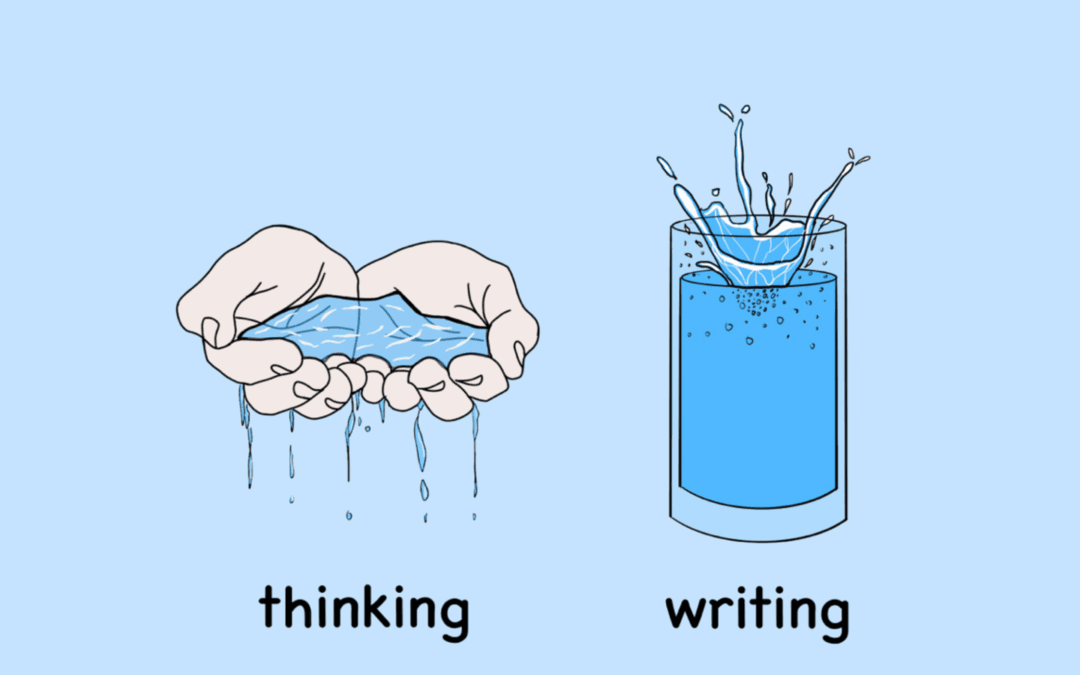
The Organizational Psychologist and Professor Adam Grant says, “Writing isn’t what you do after you have an idea. It’s how you develop an inkling into an insight. Turning thoughts into words sharpens reasoning.” Many writers, professors, psychologists, and others have made similar points about writing being a form of organizing and exploring our thinking.
Following this line of thinking, we might say that writing essays is a process of developing and polishing your ideas. For example, while you probably know what your career goals are, writing an essay about your goals offers an opportunity to explore your values and motivations to a deeper degree. Explaining these values and motivations helps the admissions committee understand how you will approach your career, and they are the kinds of details that establish your profile as distinctly your own, setting you apart from other applicants. Uncovering these underlying factors can even reveal valuable connections with your target programs’ values and teaching style, which you will also want to point out in your essays.
Discovering these insights about ourselves often comes from asking “why?” as a way to dig into the analysis of our ideas and goals. This is critical thinking through writing. By comparison, AI doesn’t know why you like things; that’s why most of its outputs and supporting information will be generic rather than personalized and expressive.
From a writing perspective, consider that after we write a topic sentence to start a paragraph, we must develop supporting information to validate and explain the topic. However, some applicants do not have a clear career goal when they start their applications. These people can use essay writing to explore the kinds of problems or challenges they want to work on, such as helping supply chain companies use data to improve efficiency, or consulting with corporations to achieve their social responsibility goals. Once this preference is identified, the applicant can research the kinds of roles that work on those business problems and use that information to share believable career goals. This is one way to use critical thinking to develop main ideas as well as supporting information.
AI is Useful, But At What Cost?
Using an AI tool to draft an essay can save considerable time and effort, but the tradeoffs are many. As mentioned above, AI essays lack real information and insights about you, as well as your personal writing style. Another consideration is the risk of rejection for using AI tools. Many universities are vocal about their use of AI-detection software, and some will throw out an essay that appears to have been generated using AI. Lastly, the TIME article noted that test subjects who used ChatGPT in the MIT study “consistently underperformed at neural, linguistic, and behavioral levels.” That means those users experienced decreased brain activity, unique expression, and behavioral traits, such as creativity.
Critical thinking and writing skills are business skills that need to be practiced to stay sharp. At Transcend Admissions, we use proprietary methods developed over many years to inspire clients to spend dedicated time thinking critically about their essay content before writing, while writing, and throughout the editing process. If you would like to better understand how we can help you write original essays in your own authentic voice, request a free 20-minute consultation today.